The Noticeboard as a Map of Local Free Time
A noticeboard map of local free time reveals which hobbies, gatherings, and recurring events a shared space makes easy to discover and join.
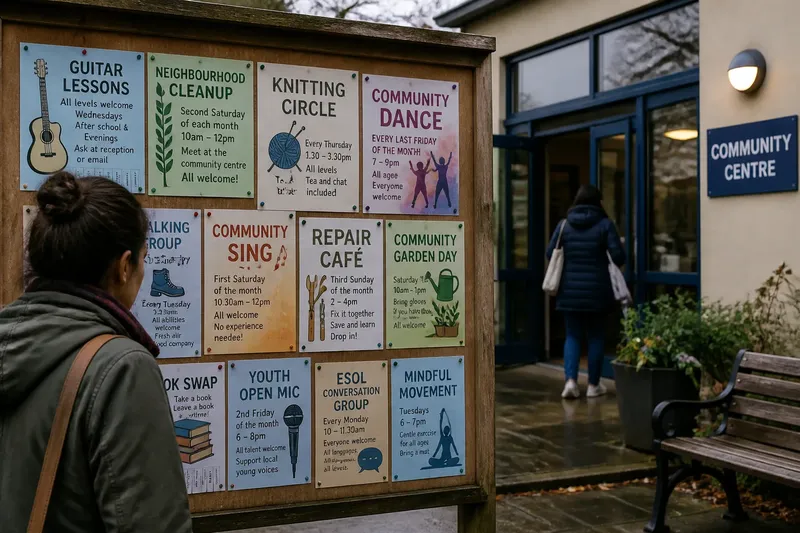
You stop to read the noticeboard beside the community center’s entrance while a friend looks for the restroom. A guitar lesson, a neighborhood cleanup, a knitting circle, and a flyer for a monthly dance compete for space. Taken together, they form a noticeboard map of local free time: not a full picture of everything nearby, but a useful record of what a shared local space makes visible.
Read the board for its patterns as well as its individual invitations. The recurring dates, types of activities, and gaps between notices can show which kinds of leisure are easy to find, who appears to be invited, and what might take a little more asking around.
1. Start with what returns to the board
A recurring event tells a different story from a single announcement. A weekly chess meetup or monthly community sing suggests that someone has made room for an activity to happen again, rather than simply advertising a one-off occasion. Look for phrases such as “every Thursday,” “first Saturday,” or “drop in each month.”
Regularity can make an activity easier to fit into ordinary life. A person who misses one gathering may have another chance soon, while a single-date notice requires more careful timing. The board does not tell you whether a group is welcoming or active, but recurring dates offer a clear starting point for checking.
Notice the kinds of activities that recur, too. If the same space regularly lists walking groups, board games, and craft circles, those routines are part of the leisure it puts in front of visitors. A one-time concert may draw attention, while the repeating notices reveal what is likely to be there on an ordinary week.
2. Read the calendar as a picture of local rhythms
Dates show how leisure is distributed across the week and across the seasons. An evening reading group, a weekend repair café, and an afternoon garden gathering point to different rhythms of use. They may help you see whether the space mainly offers activities after work, during school hours, or on days when more neighbors are free.
Pay attention to clusters and quiet stretches without treating either as proof of what the community wants. Several events around a holiday may reflect a temporary program; a sparse calendar could simply mean that organizers post elsewhere. A board is a window into what is being advertised there, not a census of local interests.
The calendar can also help you choose a first outing that suits your routine. If you prefer a short visit before dinner, a notice for an early evening community choir may be more useful than an all-day fair. If your schedule changes often, open gatherings with repeated dates may be easier to explore than events tied to a single afternoon.
3. Look at the verbs to see how people take part
The wording on a flyer gives clues about the role a visitor is expected to play. “Watch,” “listen,” and “attend” point toward an audience experience. “Bring,” “make,” “share,” and “help” suggest that participants contribute something, whether it is a dish, a skill, or a few minutes of their time.
Neither kind of activity is more valuable. A small concert can be a welcome way to spend an evening without making a commitment; a community garden day may suit someone who enjoys working alongside others. Reading the verbs helps you picture the experience before deciding whether it fits.
Notice whether an invitation names a specific contribution. “Bring a favorite recipe to share” is more informative than “join our food event.” Concrete wording can make it easier to judge what to expect, while a vague notice may leave room to ask the organizer for details.
4. Notice who seems able to say yes
A board’s practical details shape who can respond to an invitation. A clear meeting place, a contact name, and information about registration give a reader something to act on. If a notice lists a time but no location or way to ask a question, the event may be harder for a newcomer to approach, even if it sounds appealing.
Look for the audience the wording addresses. “All ages,” “beginners welcome,” or “bring a neighbor” signals an intended invitation; language that assumes prior knowledge may suggest a group formed around an established interest. These phrases are clues, not promises, so a quick call or message can clarify what participation involves.
Practical access matters as well. A flyer may mention a quiet room, a family-friendly setting, or step-free entry, but it may not include every detail a visitor needs. If access needs are relevant, contact the named organizer or venue before making plans. For matters governed by local rules or the venue’s own policies, check those directly rather than relying on a small notice.
5. Compare the kinds of leisure sharing the wall
Sort the notices loosely into categories as you read: creative activities, movement, conversation, volunteering, performances, or learning. The point is not to turn a casual stop into a formal audit. It is to notice which kinds of free time are represented again and again, and which appear only occasionally.
For instance, a board filled with exercise classes and volunteer shifts offers a different visible menu from one featuring open mics, language exchanges, and neighborhood suppers. Each mix can be useful to different people. The pattern tells you what the space is currently making easy to discover, not what people ought to enjoy.
Imagine you visit a library lobby hoping to meet people through a shared hobby, but the board mostly shows classes and service announcements. You could note the contact details on a recurring craft circle, then ask whether newcomers can sit in before bringing supplies. The likely observable result is simple: you learn whether that particular invitation fits, without assuming the board lists every social group nearby.
6. Treat missing notices as questions, not answers
A blank patch of wall does not necessarily mean there is no local activity. A group might use a mailing list, a social media page, a café window, or word of mouth instead. The noticeboard shows what has reached that surface, so its silences are best treated as prompts for a little further curiosity.
If you hoped to find something the board does not show, ask the desk staff whether another local listing is available. You might also check a nearby community center or independent shop that keeps its own notices. This is not a search for a perfect directory; it is a way to avoid mistaking one wall for the whole neighborhood.
Missing information can also be useful feedback for organizers. If a notice gives no contact route, newcomers may not know how to follow up. A reader who wants to join can ask the venue whether it has current details, while an organizer can make future notices easier to act on by including a clear next step.
7. Use the board to choose a small first visit
Once a notice catches your eye, focus on the details that help you decide whether to try it: date, time, location, how to join, and whether you need to bring anything. Some boards display old flyers alongside current ones, so confirm that the date has not passed. If a contact is listed, a short question can clear up uncertainty before you set out.
Say you spot a monthly drawing group at a neighborhood hall and feel curious but unsure whether it is for experienced artists. You could message the organizer to ask if beginners can attend and whether paper is provided. You would then know what to expect before choosing a date, rather than turning a casual outing into a stressful guess.
Start with one activity that suits the time and energy you have, not with an effort to sample everything. A noticeboard map of local free time works best as an invitation to make one informed choice: follow a recurring date, ask about a detail, or look for a different venue whose mix feels closer to what you enjoy.
What should you check before following a notice?
How can I tell whether an event is still current?
Check the date on the flyer and look for a recent update or contact route. If the notice has no clear date, ask the venue or organizer before traveling.
What does “drop in” usually tell me?
It suggests that visitors may arrive without registering, but it does not explain whether supplies, space, or a fee are involved. Contact the organizer if any of those details would affect your decision.
How do I find out whether newcomers are welcome?
Look for wording such as “beginners welcome” or “new members invited,” then ask the listed contact if the notice is unclear. A direct, friendly question can reveal how a first visit works.
What if the board does not list the activity I want?
Ask staff whether they know of another local noticeboard or community calendar. The missing listing may reflect where that group advertises, rather than an absence of the activity itself.
A local board is most useful when you read it as a living notice of what a shared space is inviting people to do, not as a complete guide to everyone’s free time. Before you leave, note one recurring event and one question you want answered; that small habit can turn a passing glance into a more thoughtful next outing.